Nurses In Schools: For the Health and Wellness of All Students
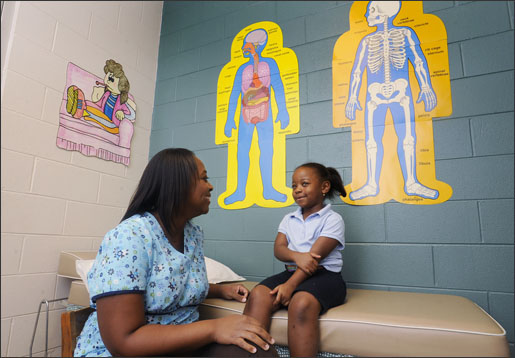
 Retreived from http://www.lonejackc6.net/vnews/display.v/SEC/District%7CDepart ments%3E%3ENurse | Introduction: Why Nurses in Schools?Nurses in school settings play an enormous part in improving the health of students, have a healthy atmosphere to learn and mature. According to the National Association of School Nurses (2010), school nursing is a specialized practice of professional nursing that advances the well being, academic success, achievement and health of students. School nurses provide health care to all members of the school population, perform health screening and organize referrals to medical home or private health care providers (NASN, 2010). School nurses work together with school employees, families, the community and health care providers to coordinate work, and to (delete) be a support for (delete the) the health care and create a healthy school environment (Lee, 2011). In addition, school nurses assist with the normal development of children, promote health and safety, mediate with actual and potential health issues, provide case management services and actively collaborate with others to build student and family capacity for modification, self‐management, self advocacy, and learning (NASN, 2010). |
Importance of a School Nurse Please watch entire video.  Retrieved from http://californiaschoolnursesorganization-sandiego.yolasite.com/ | Retrieved from http://www.youtube.com/watch?v=-Wj61gb5Zng |
Role of a School Nurse
The main role of a school nurse is broad and it depends on many aspects; it includes the location of the school, health needs of students and the accessibility of specific student support services and programs (NASN, 2010).
1) School nurses facilitate normal development and positive student response to interventions (NASN, 2010).
→ Nurses work to meet health needs of students’ based on understanding the normal growth and development in children, youth and students with special needs. They develop individual care plans for students based on the nursing process of assessment, intervention, planning and evaluation.
2) School nurses offer leadership in promoting health and safety, including a healthy environment (NASN, 2010).
→ Nurses are responsible to checking immunizations, controlling infectious diseases, assessing school environment for safety to prevent injury and organizing infection control measures. Besides, they develop school safety plans to address bullying, school violence, and range of problems that may arise at school (NASN, 2010).
3) School nurses provide quality health care and intervene with actual and possible health problems (NASN, 2010).
→ Major focus for nurses is health care for chronic and acute illnesses. They are in charge for medication administration, first aid procedures and other health care (Lee, 2011). For instance, nurses are available to provide immediate treatment for minor injuries such as headache, pain, or changing dressings and main issues such as asthma or diabetes.
→ Nurses also incorporate health screenings sessions for vision, hearing, body mass index, mental health index or other health related issues (NASN, 2010). Screening allows nurses to identify circumstances that present barriers to students learning so that appropriate interventions are implanted (Baisch et al, 2011).
4) School nurses use clinical judgment in providing case management services (NASN, 2010).
→ Nurses receive medical orders to direct the health care needed to assist each student to be safe and successful at school.
5) School nurses actively collaborate with others to build student and family capacity for adaptation, self management, self advocacy and learning (NASN, 2010).
→ School nurses have skills that are essential to school educational teams, such as the Committee on Special Education, the Individualized Educational Plan team so that health related barriers to learning can be reduced for each student (NASN, 2010).
→ Provide families with referral information along with available community resources to improve access to health care (Lee, 2011). They also assist families in obtaining health insurance and advocate for school based health care.
Case Study Mary is a school nurse and has just begun working in a public elementary school in Toronto. The Grade 3 teacher, Mrs. Smith, has come to speak with Mary because she is concerned about one of her students, Bobby. Bobby is an eight-year-old boy who has recently been diagnosed with type 1 diabetes. When Mary checks Bobby’s blood glucose, he is often hyperglycemic. Mrs. Smith tells Mary that she has noticed that at lunch times, Bobby tries to trade his healthy snacks for other sugary treats that he is no longer allowed to have. Mrs. Smith says she has intervened several times, but Bobby continues to try and eat sugary snacks. The gym teacher also reports that Bobby is extremely active in gym class and Mrs. Smith has noticed that after gym Bobby has difficulty concentrating and appears clammy and fatigued. 1) What issues would the nurse be the most concerned about in Bobby’s case? 2) What should the nurse include in Bobby’s plan of care? 3) What information should the nurse give to Bobby’s teachers to help them support Bobby’s health? 4) What is the importance of having a nurse in schools? |
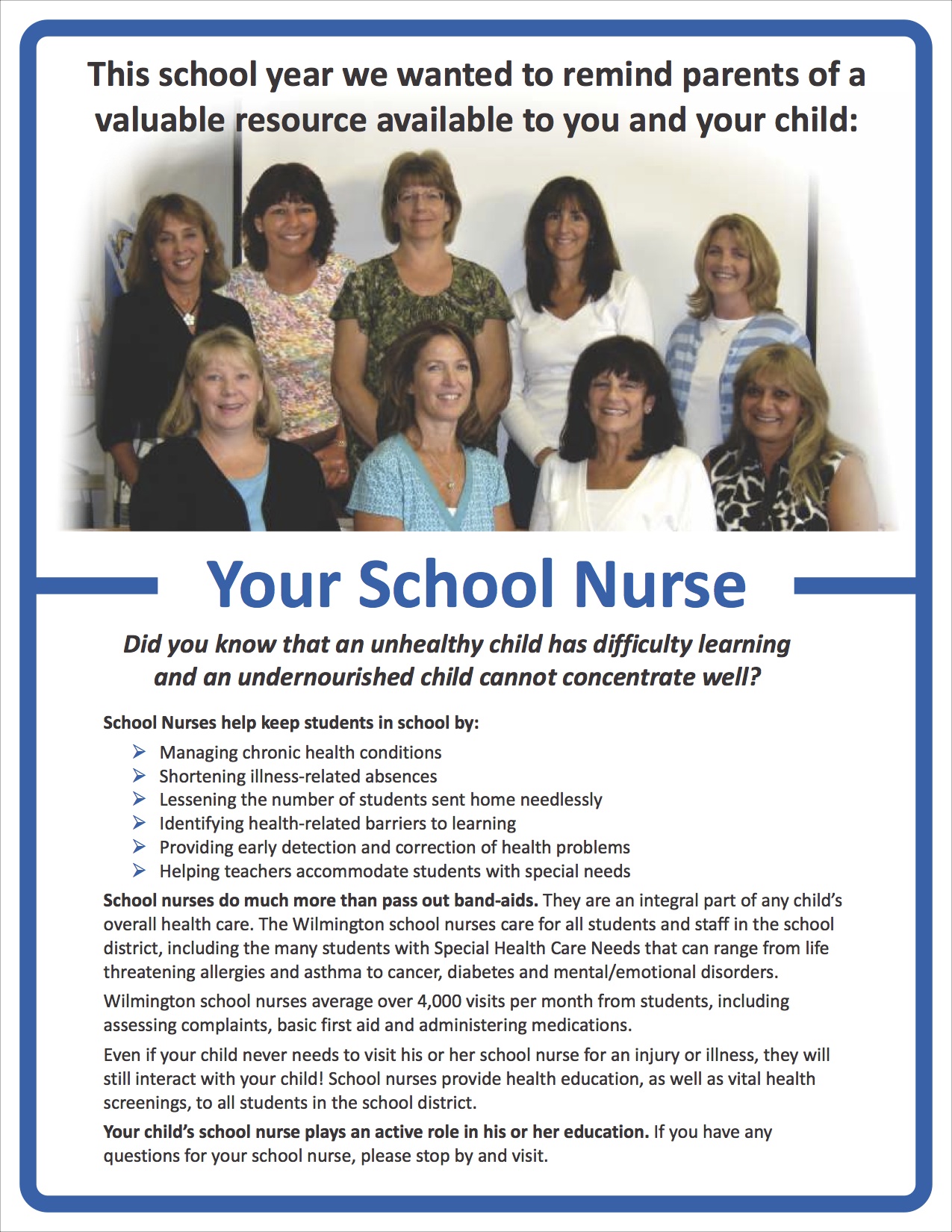
Retrieved from http://www.wilmington.k12.ma.us/Health/Wilmington%20School%20 Nurse% 20Flyer%20~%20no%20symbol%20FINAL.pdf |
What do you think?
References Baisch, M., Lundeen, S., & Murphy, M. (2011). Evidence-based research on the value of school nurses in an urban school system. Journal of School Health, 81(2), 74-80. doi:http://dx.doi.org.ezproxy.library.yorku.ca/10.1111/j.1746-1561.2010.00563.x Hawkins, J. W., Hayers, E. R., & Corliss, C. P. (1994). School nursing in America- 1904-1994:A return to public health nursing. Public Health Nurse, 11, 416-425. Retrieved from htttp://web.ebsochost.com.ezproxy.library.yorku.ca/ehost/detail?vid=7&sid=5a8742fa-b109-46249c3682009fee8 085%40sessionmgr115&hid=112&bdata=JnNpdGU9ZWhvc3 QtbGl2ZQ%3d%3d#db=rzh&AN=199500730 Lee, R. (2011). The role of school nurses in delivering accessible health services for primary and secondary school students in Hong Kong. Journal of Clinical Nursing, 20(19/20), 2968-2977. doi:http://dx.doi.org.ezproxy.library.yorku.ca/10.1111/j.1365-2702.2011.03782.x National Association of School Nurses (NASN) (2010). Definition of school nursing. Retrieved from: http://www.nasn.org/Default.aspx?tabid=57 Ontario Ministry of Education, (2006). Community Use of Schools Program. Retrieved from:http://faab.edu.gov.on.ca/Memos/B2006/B_1 3.pdf Pollitt, P. (1994). Lina Rogers Struthers: The first school nurse. The Journal of School Nursing, 10 (1). Retrievedfromhttp://web.ebscohost. com .ezproxy.library.yorku.ca/ehost/detail?vid = 9&sid=5a8742fa-b109-4624-9c36-82009fee8085%40sessionmgr115&hid=112&bdata =JnNpdGU9ZWh vc3QtbGl2ZQ%3d%3d#db=rzh&AN= 1994185588 Schumaher, C. (2002). Lina Rogers: A pioneer in school nursing. The Journal of School Nursing, 18 (5). Retrieved from http://web.ebsc ohost.com.ezproxy.library.yorku.ca/ehost/ detail?vid=11&sid=5a8742fa-b109-4624-9c36-82009fee8085%40sessionmgr115&hid=112 &bdata=JnNp dGU9ZWhvc3QtbGl2ZQ%3d%3d#db=rzh&AN=2003030577 Stamler L. L. & Yiu L. (2012). Community Health Nursing A Canadian Perspective. Chapter 17:School Health, 283-300. Toronto, Ontario: Pearson Canada Inc. |
Site created by: Gizman Abdullahi, Mihai Borcan, Alyse Gough, Lauren Howorth, Natalya Linetska & Anna Remisiewicz