A Historical PerspectiveSchool nursing has seen many changes during this century and today are more involved and responsible than ever for student health and wellness. A historical perspective of the times will help you to understand the issues surrounding the implementation of nursing practice into the schools. First school health services in the United States started in Boston in 1894 for medical inspections only (Hawkins, Hayers, & Corliss, 1994). These inspections were designed to identify for exclusion from school students with serious communicable diseases and later inspections were broadened to include screenings for parasitic diseases. The major problem with these medical inspections was no follow-ups were done on those children who were excluded from school (Hawkins et al., 1994). Therefore, in 1897, New York City hired 150 doctors in order to inspect children in school for transmittable diseases and to exclude them as necessary (Hawkins et al., 1994). The physicians sent the affected children home with written instructions for recommended follow-up. However, many of the parents could not read, and most could not afford the recommended care. As a result, the recommended treatments were not initiated, and the affected children continued to spread diseases to other children after the school. Therefore, NYC Board of Education suggested implementing a more effective school health program using nurses. At that time, Ms. Wald, a public health nurse and social reformer from New York City, proposed to the Board of Education to allow her to place a public health nurse in four schools, with a total of ten thousand students on an experimental basis to increase school attendance by educating students and families regarding health care needs related to the spread of communicable diseases among children (Hawkins et al., 1994).Therefore, the practice of school nursing began in the United States on October 1st, 1902, when Lina Rogers Struthers, a Canadian nurse, was chosen to lead this experiment in NYC for a period of one month (Schumaher, 2002). As part of her role in the schools, Ms. Rogers made visits to assess students’ homes and to assist the students and their families in the management of diseases and ailments (Schumaher, 2002). In the first week of the experiment, Rogers treated 893 students, made 137 home visits, and helped 25 children who had received no previous medical attention recover and return to school (Schumaher, 2002). After one month of successful nursing interventions in the New York City schools, Lina Rogers became officially the first school nurse (Schumaher, 2002). She was able to become liaisons between schools and community and provide leadership to implement evidence-based nursing care across the city. At the end of the month the results were so promising that the NYC Board of Health continued her appointment. By December, 1902, she was named a Superintendent of School Nurses with a staff of 12 nurses. Two months later 15 more nurses were hired (Hawkins et al., 1994). During the first year health-related absenteeism was significantly reduced by nearly 90% and school nursing was well on its way as a distinctive and vital nursing specialty. Within a few years, school nursing program began to grow and in 1905, school nurses treated over 900,000 cases of infections and made over 40,000 home visits (Hawkins et al., 1994). Some of the innovations Rogers brought to her position included: advocate for wellness and illness-prevention programs, encourage teachers to present lessons in hygiene, nutrition and physical development; introduce paper towels for hand drying, and promote implementation of dental screenings in schools (Schumaher, 2002). These were the beginnings of the shift in health care priorities in schools and community from health inspections to a model that focused on prevention and education. A statistical comparison of the number of students excluded for communicable diseases before and after the hiring of the school nurses were revealed. In September, 1902, 10,367 students were sent home, whereas in September, 1903, only 1,101 students were excluded. As a result of the success of the experiment in New York, other large cities such as Los Angeles (1904), Boston (1905), Philadelphia (1908), Pueblo (1909) and Chicago (1910) began hiring school nurses. Within a few years, school nursing program began to grow, and resulted in the employment of a nurse in every school in New York City. By 1914, there were close to 400 nurses working in schools (Hawkins et al., 1994). The first school nurses were appointed in Hamilton, Ontario, in 1909, and Toronto in 1910. Lina Rogers returned to Canada in 1913, where she started school nursing programs composed of nurses, dentists, and physicians, providing comprehensive school health services (Schumaher, 2002). She had achieved international fame for her work correlating the absence of children from school with lack of medical care. Her appointment to the School Nursing Service of the Toronto Board of Education led to recruitment of a staff of nurses and dentists, with a mandate to teach children and their families’ hygienic practices to prevent diseases (Pollitt, 1994). A several years later the Nursing Service was transferred to the health department, providing a model for a system of public health nursing in each province. The beginning of World War II had a significant effect on nursing in schools. The role of the school nurse shifted from care-giver to health educator and public health nurse, with a focus on family-centered care for students, home visits, and health needs of the students' family (Hawkins et al., 1994). Nurses continued the implementation of special services such as dental-health education, screenings and referrals for handicapped students (Hawkins et al., 1994). Communicable disease control remained an important part of the school health program. In the 1950s, the focus of school nursing continued to be focused on management of student illness and behavioral health outcomes with mental, spiritual and emotional health. The school nurse conducted formal and informal health education for students both in and out of the classroom. School nurses were becoming more familiar with the health curriculum and in the instruction of health lessons (Hawkins et al., 1994). From 1952 through 1962, nurses working in schools had doubled in numbers (Hawkins et al., 1994). The 1970s brought about major changes in existing school health programs due to societal problems, such as chemical drug dependency, sexual permissiveness, rising divorce rate, teenage delinquency, venereal disease and teenage pregnancy (Hawkins et al., 1994). Mainstreaming became the philosophy of educators and the role of school nurses emerged as advocates for the rights of handicapped children in schools. In conclusion, during the twentieth century improvements in housing, sanitation and public health practices, and the discovery of vaccines and antibiotics, shifted the focus of health care in the school setting from medical inspections to health screenings and health education, thereby overextending school nurses role and responsibilities. Today: Although school nurse’s impact on the health and well-being of today’s students is certainly invaluable, at times the school nurse’s influence is not so easily measured or recognized. Poverty, homelessness, teenage pregnancy, drug use, HIV/AIDS, single-parent households, working parents, eating disorders, and suicide are some additional priorities for school nurses today. |
Retrieved from http://www.workingnurse.com/articles/lina-rogers-the-first-school-nurse 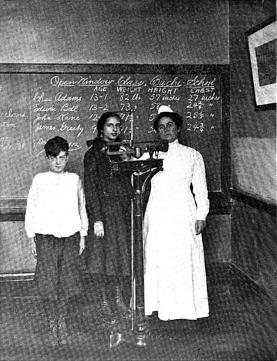 Retrieved from http://publicdomainclip-art.blogspot.ca/ 2011/09/school-nurse-weighing-and-measuring.html 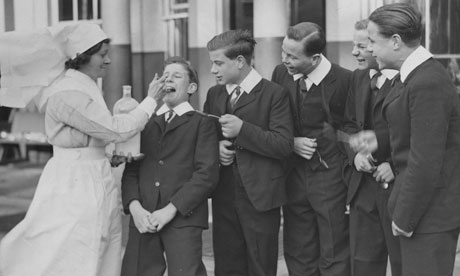 Retrieved from http://www.guardian.co.uk/healthcare-network/201 2/may/16/get-ahead-school-nursing 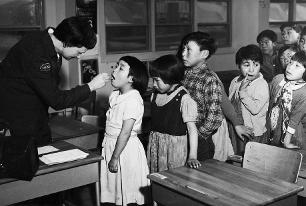 Retrieved fromhttp://resources.cpha.ca/CPHA/ThisIsPublicHealth/s oundbites/item.php?i=361&l=E 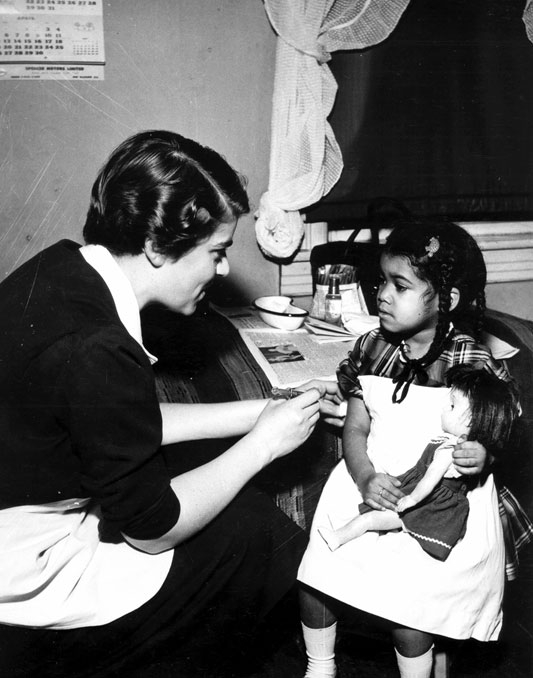 Retrieved from http://cahn-achn.ca
 Retrieved from http://pinterest.com/pin/18647785928638666/  Retrieved from http://www.nysut.org/newyorkteacher_11026 .htm  Retrieved from http://www.randolph.k12. nc.us/Departments/Stude nt%20Services/schoolnurses/Pages/Default.aspx |
